


Cold Rolling Shaft
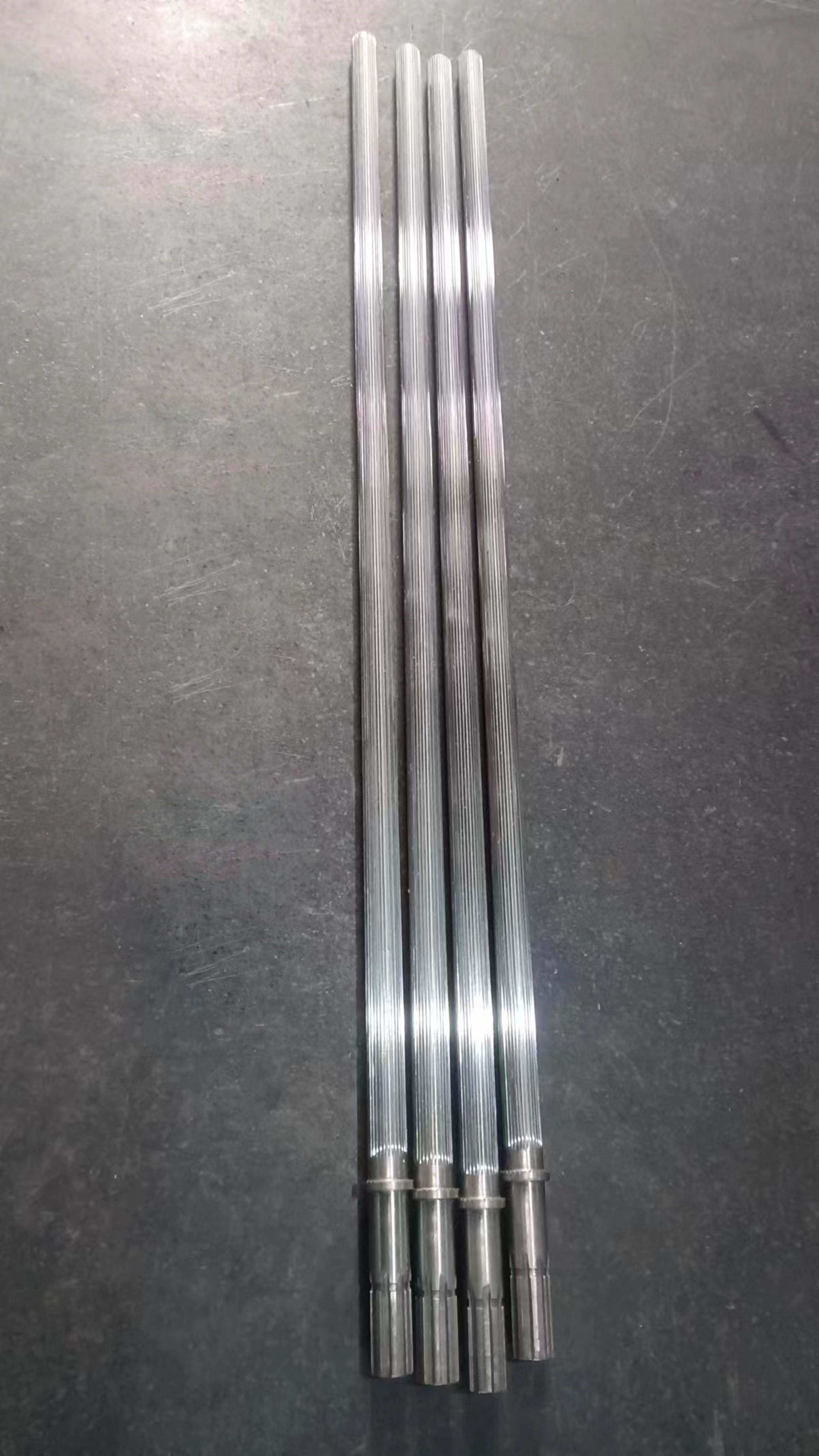
Model:φ10 mm ~φ140mm
Length: Up to 15 meters at maximum
Applicable Brands: Most well-known extruders on the market
Material: High-Torque Alloy Steel (with a torque rating up to 18Nm/cm²)
Properties:Wear-resisting, Corrode-resisting and durable
Spline Types:DIN5480, JIS-B-1603, GB3478 Involute Splines, Hexagonal Keys, Flat Keyway Semi-Circular Keys, Rectangular Splines
Manufacturing Principle of Cold-Rolled Shaft:
Cold-rolled mandrels are manufactured based on the principle of metal plastic deformation, achieving integrated forming of the shaft body and splines/teeth via cold rolling. The process involves: selecting high-strength alloy steel (e.g., 42CrMo, high-speed steel) pre-conditioned by quenching and tempering; applying radial and axial composite pressure to the billet using specialized cold-rolling dies (with preset tooth or thread profiles); causing metal to plastically flow along the die cavity at room temperature to directly form the required tooth shapes, keyways, or surface textures; and finally performing low-temperature tempering to eliminate internal stress and improve dimensional stability. The entire process requires no cutting, with metal fibers continuously distributed along the forming direction, avoiding material waste and internal structural damage.
Functional Advantages:
High Strength and Wear Resistance:Cold rolling induces work hardening on the metal surface (hardness increased by 15%-25%), with continuous and intact fiber structure. Torsional strength is 20%-30% higher than traditional milled shafts, and tooth fatigue life is extended by over 50%, making it suitable for high-torque, high-speed transmission scenarios (e.g., screw extruders, precision machine tool spindles).
High Precision and Surface Quality:Through the forced forming effect of the die, the dimensional tolerance of the cold-rolled shaft can be precisely controlled to a higher accuracy level, while the surface roughness is significantly reduced. This effectively minimizes assembly gaps and friction loss, thereby improving overall transmission efficiency.
Material Utilization and Production Efficiency:Eliminating material removal in cutting processes increases material utilization from 60%-70% (traditional milling) to over 90%; cold rolling as a continuous forming process shortens single-shaft processing time by 40%-60% compared to milling, suitable for mass production.
Structural Integrity and Reliability:Integrated forming avoids stress concentration from welding or splicing, enhancing overall shaft rigidity. It resists fracture under impact loads, ideal for industrial environments with frequent vibrations (e.g., construction machinery, automotive gearboxes).
Adaptability to Complex Conditions:After surface treatments (e.g., nitriding, chrome plating), it gains corrosion resistance and anti-seizure properties, enabling long-term stable operation in dusty, humid, or slightly corrosive environments, reducing maintenance frequency.


