


Views: 0 Author: Site Editor Publish Time: 2026-06-29 Origin: Site


Premature wear in compounding and extrusion systems disrupts entire production cycles. Unpredicted downtime quickly drains facility profitability. Equipment degrades internally, leading to inconsistent shear rates across the barrel. Replacing compromised elements consumes thousands of dollars unexpectedly. Processors lose valuable time trying to stabilize polymer melt pressures.
The operational reality demands highly resilient hardware. You cannot process abrasive fillers like glass fibers or calcium carbonate using basic components. Corrosive additives degrade standard metals rapidly. Off-the-shelf parts simply fail under such aggressive processing conditions. High-torque applications require specialized engineering solutions.
We designed this guide to help process engineers avoid catastrophic mechanical failures. You will discover a transparent, technical framework for component evaluation. We will help you select equipment balancing torque demands and metallurgical resilience. You will learn to optimize your extrusion process for maximum reliability and sustained output.
Base metallurgy choices on the specific abrasion and corrosion profiles of your raw materials, not generic manufacturer claims.
Spline design directly dictates maximum torque transmission; involute splines offer superior load distribution for high-torque engineering plastic compounding.
Dimensional accuracy and tight tolerances are critical to prevent element galling and streamline maintenance during changeovers.
Credible suppliers should provide verifiable metallurgical certificates and non-destructive testing (NDT) reports to guarantee internal shaft integrity.
High-viscosity polymers put immense mechanical stress on the Screw Shaft. Sheer mechanical overload causes severe torsional fatigue. The core metal essentially twists repeatedly until micro-cracks form. These tiny cracks propagate silently beneath the hardened surface. Eventually, a catastrophic snap halts production immediately. Engineers often misdiagnose this as a material defect. In reality, it stems from exceeding the maximum torque yield point. Gradual material degradation looks entirely different. Abrasive wear strips away the outer surface layer over thousands of hours. You must identify which failure mode plagues your system first. Resolving torsional fatigue requires upgrading core toughness. Resolving abrasive wear requires upgrading surface hardness.
Processing fiberglass or talc acts like heavy-grit sandpaper inside the barrel. Recycled regrind frequently contains unpredictable, hard contaminants. These harsh materials accelerate wear on load-bearing surfaces rapidly. The spline teeth begin to thin out. Element slippage soon follows. Melt pressure drops unexpectedly during continuous runs. Here are the primary consequences of unchecked abrasive wear:
Loss of conveying efficiency along the entire screw profile.
Poor dispersion of colorants and sensitive chemical additives.
Increased energy consumption due to extreme mechanical inefficiency.
Frequent element replacement cycles draining maintenance budgets.
Fluoropolymers and flame retardants hide a subtle, destructive danger. They release acidic byproducts upon reaching high melt temperatures. This chemical attack pits the raw steel surface continuously. Standard hardened steel cannot withstand this acidic environment. Pitting weakens the structural integrity over time. You need specific acid-resistant alloys to combat this unseen threat. Processors often mistake corrosive pitting for standard mechanical wear. Proper visual inspection reveals distinct micro-craters indicative of acid attack. Operators must adjust their metallurgy immediately when processing halogenated compounds.
This material represents the absolute baseline for many manufacturers. They use it extensively for standard single and twin extrusion tasks. It handles non-abrasive compounding surprisingly well. The surface hardening process creates a tough outer shell. It remains highly cost-effective for everyday, low-stress operations. However, heavy-duty applications overwhelm it quickly. The softer core lacks the structural toughness needed for extreme mechanical stress. We recommend restricting nitrided alloys to basic polyolefin processing.
Consider this category the standard for demanding industrial environments. Twin-screw compounding of engineering plastics demands serious torque capacity. These specific alloys deliver the necessary tensile strength reliably. They resist twisting forces beautifully under full operational load. Processors rely on them for consistent day-to-day compounding. The precise combination of chromium, nickel, and molybdenum creates exceptional core resilience. Deep quenching and tempering protocols maximize their lifespan.
Extreme environments require extreme material solutions. High-percentage glass fiber applications shred standard tool steel effortlessly. Aggressive plastic recycling introduces constant, severe shock loads. Powder metallurgy (PM) alloys offer incredible wear resistance. The specialized manufacturing process ensures uniform carbide distribution globally. This dense carbide network stops deep abrasion in its tracks. They outperform traditional cast alloys significantly in aggressive chemical environments.
Selecting the right alloy requires mapping your process parameters correctly. Base your decisions on actual formulation data rather than assumptions. Use the table below as a reliable baseline for material selection.
Polymer Type & Fillers | Recommended Material Category | Minimum Rockwell Hardness (HRC) | Key Operational Benefit |
|---|---|---|---|
Standard Polyolefins (No fillers) | Nitrided Steel (38CrMoAlA) | HRC 58-62 (Surface only) | Maintains high cost-efficiency for low-stress tasks. |
Engineering Plastics (<30% Glass) | High-Torque Tool Steel (WR Series) | HRC 55-58 (Through-hardened) | Balances core toughness and necessary torque capacity. |
Extreme Fillers (>40% Glass, Talc) | PM High-Alloy Steels | HRC 60-64 (Through-hardened) | Provides maximum resistance to aggressive abrasive stripping. |
Fluoropolymers (PVC, PVDF) | Corrosion-Resistant Superalloys | HRC 50-55 (Base matrix) | Resists severe acid pitting and chemical degradation. |
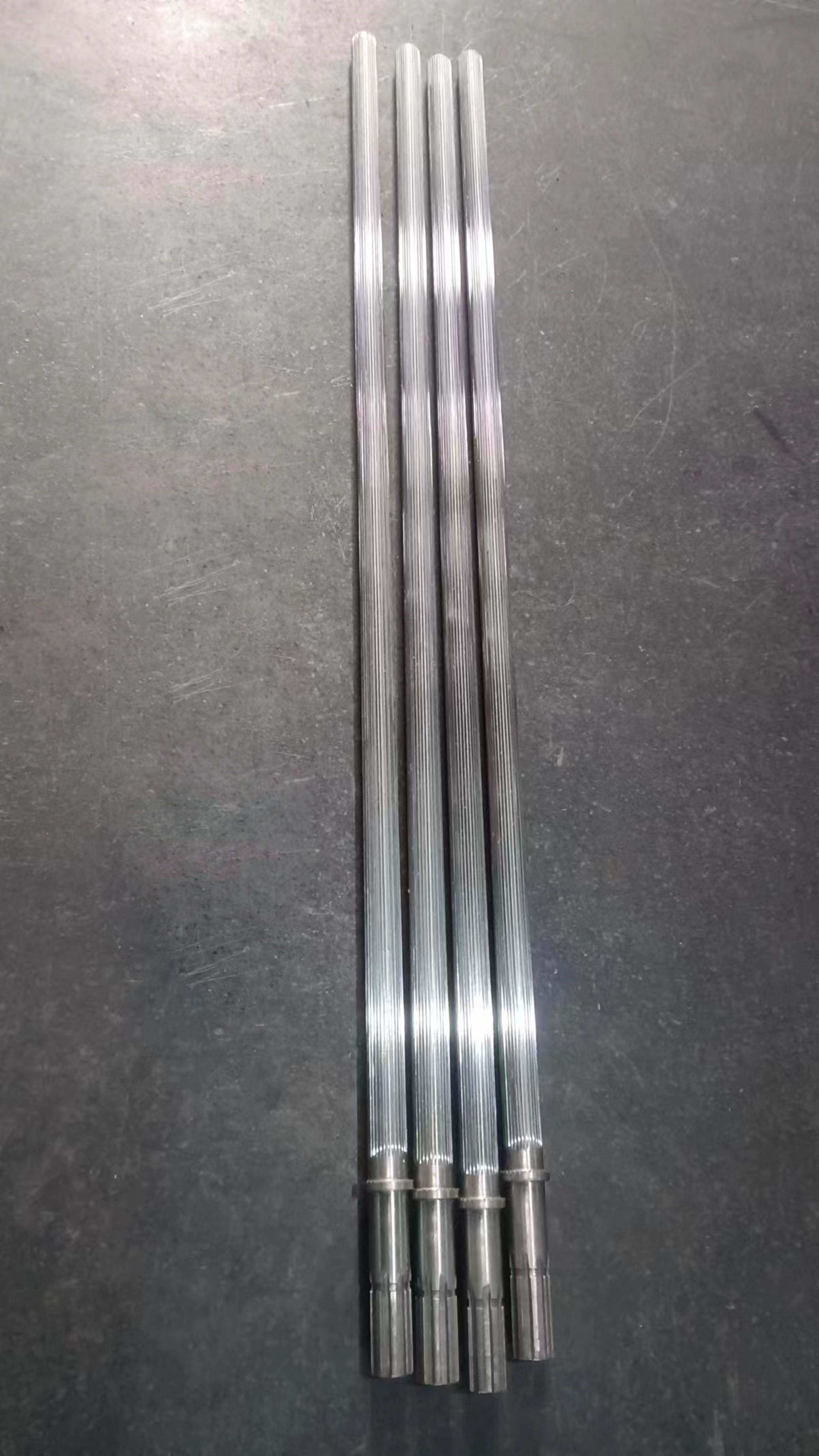
High-performance twin-screw extruders rely heavily on involute splines. Engineering professionals universally consider them the gold standard. A continuous curve design characterizes these highly precise splines. Standards like DIN 5480 govern these complex involute profiles tightly. This specialized geometry eliminates dangerous stress concentrations entirely. The smooth shape prevents catastrophic shearing when subjected to peak loads. Each individual tooth shares the rotational force equally. This even distribution enables modern extruders to achieve massive throughput rates safely.
Older legacy systems frequently feature straight or hexagonal splines. Manufacturers produce them at a significantly lower machining cost. However, they struggle under modern high-speed processing demands continually. High-torque compounding causes rapid metal fatigue in these older designs. Sharp internal corners act as massive stress magnets. Micro-cracks propagate from these exact corners eventually. The resulting mechanical failure causes severe production bottlenecks. We strongly advise upgrading from hexagonal profiles whenever your equipment allows.
Engineering reality dictates strict mathematical clearance calculations. Solid metal expands rapidly at 300 degrees Celsius inside the barrel. Spline design must strictly account for this thermal expansion behavior. Screw elements will bind tightly if initial tolerances are too tight. A properly designed Screw Shaft maintains optimal clearance across extreme temperature variations.
To manage thermal dynamics effectively, engineers evaluate several distinct factors:
Ambient installation temperature versus the peak polymer melt temperature.
Differential expansion rates between the central shaft and the surrounding elements.
Radial clearance allowances required to prevent dangerous frictional locking.
Axial growth patterns occurring during prolonged, uninterrupted processing runs.
Tight dimensional tolerances represent a strict maintenance requirement. Do not view them merely as optional manufacturing specs. Poorly machined shafts waste highly valuable production hours constantly. Maintenance mechanics struggle to slide twin screw elements off the profile. They often resort to using heavy mallets or hydraulic presses. Precision machining prevents this incredibly frustrating scenario. Smooth changeovers keep your facility running efficiently and safely.
Runout refers to the shaft wobbling during high-speed rotation. Excessive runout creates massive mechanical problems inside the heated barrel. Kneading blocks rub violently against the hardened barrel walls. Conveying elements wear down in a highly uneven pattern. This intense mechanical friction degrades the overall polymer melt quality. It introduces metallic contamination directly into the final plastic pellets. Strict concentricity controls eliminate these damaging vibrations entirely. Premium equipment often demands g6 or h6 tolerance classes to ensure stability.
A low Ra (roughness average) surface finish protects your equipment investment directly. Rough microscopic surfaces invite stubborn material adhesion immediately. Carbonized resin clings tightly to these microscopic grooves. Severe galling occurs when metal grinds against metal directly during assembly. A mirror-like, polished finish eases the rapid removal of baked-on polymers. Mechanics can clean elements much faster during complex formula changeovers. This attention to detail dramatically improves overall maintenance workflows.
Always demand comprehensive testing documentation from potential manufacturing partners. Material certifications prove the steel grade precisely matches your specific order. Ultrasonic testing (UT) reports remain entirely non-negotiable for serious processors. UT verification confirms the complete absence of internal micro-cracks. Do not purchase a Screw Shaft without reviewing these vital documents first. Visual inspections alone cannot reveal dangerous internal metallurgical flaws.
To ensure strict quality control, demand the following reports from your vendor:
Original mill certificates detailing the exact chemical composition of the steel.
Heat treatment logs showing precise quenching and tempering curves.
Dimensional inspection sheets mapping all critical spline measurements.
Dye penetrant testing results designed for surface flaw detection.
Production lines rarely operate on identical, standardized parameters. Your chosen vendor must adapt to your unique processing setup fluidly. Evaluate their distinct ability to adjust spline lengths accurately. They should customize thread depths seamlessly for your specific extruder brand. Top-tier suppliers actively modify metallurgy based on your unique process parameters. Avoid vendors pushing rigid, off-the-shelf solutions for complex compounding challenges. You need a highly capable partner able to reverse-engineer legacy profiles effectively.
Aligning shaft metallurgy and spline design with your operational demands ensures long-term reliability. Selecting the wrong alloy leads directly to catastrophic mechanical failure and lost production hours. Involute profiles and strict geometric tolerances provide the necessary foundation for high-torque stability. You must prioritize certified materials over generic alternatives to protect your machinery from abrasive degradation.
We highly recommend conducting a localized wear audit of your existing equipment immediately. Measure the current spline degradation carefully before initiating the formal procurement process. Invite your process engineers to consult directly with a technical extrusion specialist. They can match your specific compounding formulas with the optimal material grade. Take proactive action now to secure your extrusion line against unpredictable downtime.
A: Replacement intervals vary strictly based on operating hours and abrasive filler percentages. Standard compounding might allow 15,000 to 20,000 hours of continuous operation. Processing high-glass fibers can reduce this lifespan drastically. Condition monitoring remains superior to fixed timelines. Measure spline clearances during routine maintenance to predict replacement needs accurately.
A: We strongly advise against a one-size-fits-all approach. Standard plastics require lower torque and generate minimal wear. Engineering plastics demand significantly higher torque transmission and superior metallurgical resilience. Using a standard nitrided part for engineering compounding risks rapid torsional fatigue and catastrophic shearing under peak loads.
A: Plastic recycling introduces highly unpredictable regrind and frequent hard contamination. You need high-toughness, corrosion-resistant alloys to survive these extreme conditions. Powder metallurgy (PM) tool steels provide excellent shock resistance and uniform carbide distribution. They effectively combat the abrasive grit of recycled materials.
A: Look closely for predictive maintenance signs during scheduled downtime. Excessive machine vibration often indicates underlying structural weakness. Element slippage occurs when spline teeth begin deforming under heavy loads. Visible spline twisting or micro-cracking during maintenance checks signals imminent failure. Replace the component immediately if you detect these warnings.


