


Views: 0 Author: Site Editor Publish Time: 2026-06-26 Origin: Site


In twin screw extrusion, the internal mandrel serves as the essential structural backbone. It transmits raw motor torque directly into your compounding process. We often see operators focus entirely on external wear parts. However, premature shaft failure or spline fatigue guarantees catastrophic line downtime. When the internal drive mechanism shears, you face severe production losses.
This guide shifts the focus away from basic machine operations toward rigorous technical evaluation. We establish a clear baseline for evaluating metallurgy, spline geometries, and load-bearing capacities. Plant managers and design engineers require precise data to specify these components accurately. You will learn how to select and source the right components while avoiding common procurement pitfalls. Internal mechanics dictate the actual upper limits of your mixing process. Exploring precise engineering requirements keeps your extrusion lines running continuously without unexpected torsional shearing or sudden mechanical breakdowns.
Spline Geometry Dictates Capacity: Involute splines offer superior load distribution for high-torque applications compared to traditional keyed or hexagonal designs.
Metallurgy is a Trade-off: Selecting shaft materials requires balancing torsional yield strength against brittleness and corrosion resistance.
Precision Tolerance Prevents Binding: Sub-optimal machining runout on a screw shaft leads to element binding, accelerating wear and complicating maintenance teardowns.
Application Context is Crucial: Co-rotating parallel shafts require different stress evaluations than counter-rotating conical shafts due to distinct thrust and mixing profiles.
Component design dictates the maximum allowable torque an extruder can safely handle. Your chosen geometry determines exactly which screw elements you can configure along the barrel. Engineers must match the physical shape of the drive core to the operational demands of the polymer melt.
Modern extrusion relies heavily on spline geometry to transfer rotational force. Different profiles handle stress concentrations in vastly different ways.
Involute Splines: This design serves as the global industry standard for modern high-torque, co-rotating machines. The curved tooth profile drastically reduces localized stress concentrations. Engineers favor involute designs because they distribute continuous heavy loads evenly across all mating surfaces. This prevents premature metal fatigue under extreme specific torque demands.
Hexagonal and Octagonal Splines: You will typically find these profiles in legacy equipment or lower-torque applications. Manufacturers find them much easier to machine. However, they remain highly prone to localized stress at their sharp corners. When pushing high-viscosity melts, these corners act as stress risers, increasing the risk of sudden mechanical shear.
Single Keyway Designs: These remain strictly restricted to very low-shear, single-purpose applications. A single keyway concentrates all rotational force onto one narrow line. This presents the highest risk of fatigue failure under dynamic or pulsing loads.
Below is a quick reference chart comparing common spline configurations:
Spline Profile | Load Distribution | Torque Capacity | Primary Application |
|---|---|---|---|
Involute | Excellent (Curved face) | Very High | Modern Co-rotating Compounding |
Hexagonal | Poor (Stress at corners) | Low to Medium | Legacy or Light-duty Extrusion |
Octagonal | Moderate | Medium | Specialty Mid-torque Machines |
Single Keyway | Very Poor (Single point) | Very Low | Low-shear Single-purpose Lines |
The orientation and shape of the drive train heavily influence internal physics. Extruders utilize specific form factors based on the target material.
Parallel Co-Rotating Shafts: These require strict modularity and exceptionally high torsional rigidity. They support highly complex kneading and mixing element configurations. Both rotational axes spin in the same direction, demanding a Screw Shaft capable of handling aggressive radial deflection forces.
Conical Counter-Rotating Shafts: Manufacturers specialize these profiles primarily for PVC and rigid profile extrusion. They require highly customized taper angles to build rapid pressure. The counter-rotating motion forces material directly forward. This setup demands superior thrust-bearing integration to handle immense backward axial loads.
Using a standard steel alloy in a highly corrosive compounding process leads to rapid structural degradation. Different polymers release distinct off-gases. Glass-filled resins act like sandpaper against internal metals. Selecting the right metallurgy ensures operational stability.
Balancing Tensile Strength vs. Fatigue Resistance: You must analyze core materials based on their real-world yield limits under continuous operational stress. Common baselines include 40CrNiMoA, WR grades, or custom tool steels. Engineers must balance ultimate tensile strength against flexibility. A material might be incredibly strong but overly brittle. Brittle metals snap instantly under sudden torque spikes.
Heat Treatment and Surface Hardening:
Through-Hardening: This process hardens the metal uniformly throughout its cross-section. It provides massive overall strength. However, it often leaves the metal without the ductility needed to absorb sudden shock loads.
Nitriding: This surface treatment evaluates the depth of the hardened case. It prevents spline shearing on the exterior. Crucially, it keeps the inner core ductile. A ductile core flexes slightly, absorbing tramp metal impacts or cold-start shocks without snapping.
Corrosion Considerations: Fluoropolymer or high-halogen compounding creates exceptionally hostile environments. Processing these materials requires specialty high-nickel alloys or customized claddings. Standard steel quickly develops pitting along the main body. Pitting creates microscopic weak points where catastrophic fractures eventually originate.
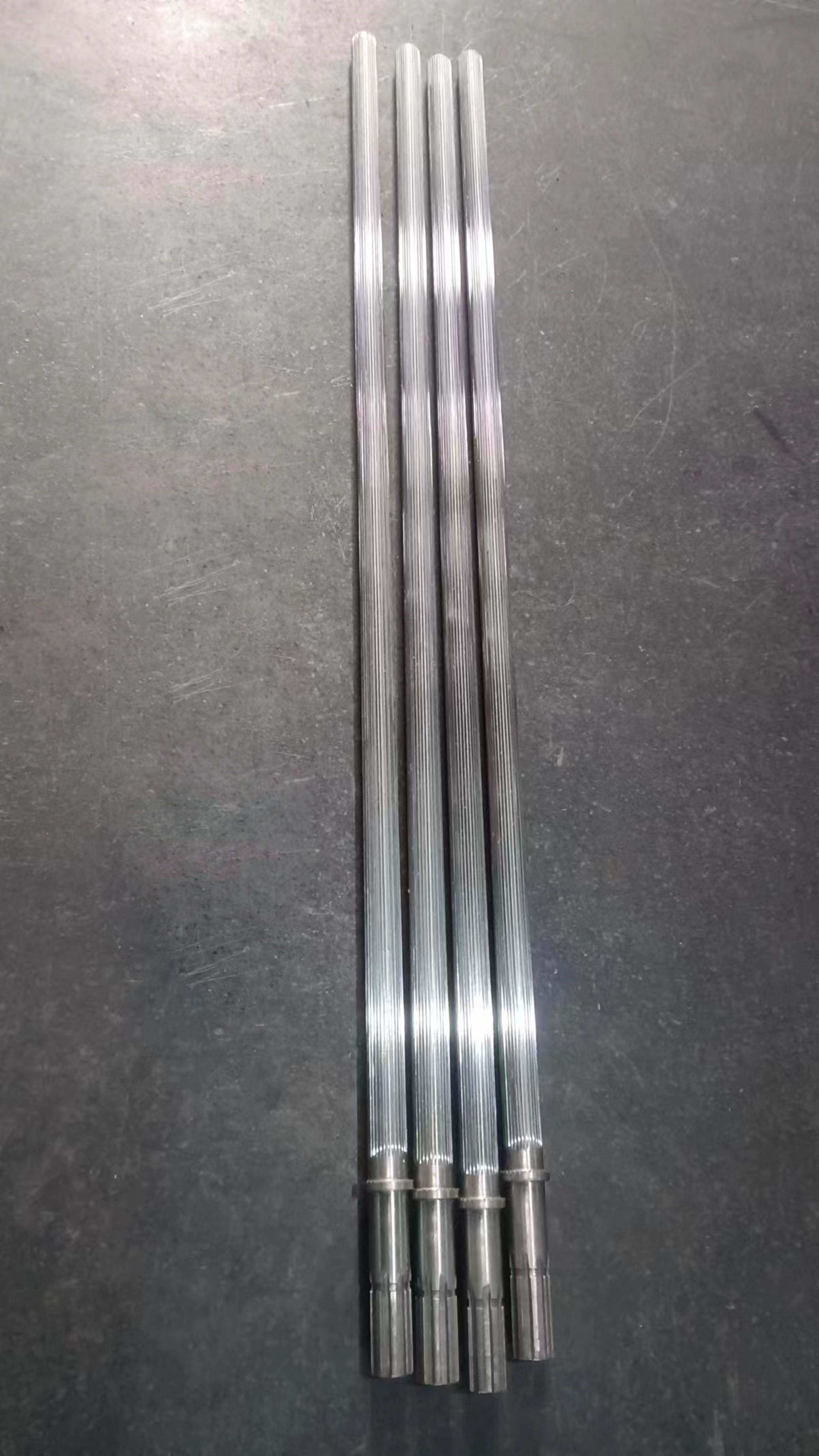
Moving from basic operational requirements to exact procurement specifications challenges many plant engineers. You must translate raw process needs into strict mechanical tolerances. A clear specification framework prevents unexpected incompatibilities.
Define Torque Density Requirements: First, calculate the required specific torque rating. You base this on motor output and exact gearbox ratios. This calculation ensures the cross-sectional area can handle peak operational loads without twisting. High-torque compounding simply destroys undersized cores.
Evaluate L/D Ratio Implications: Next, analyze your Length-to-Diameter ratio. Longer extruders increase your compounding flexibility. However, they mathematically increase the risk of internal deflection and radial wear. Mitigating this droop requires significantly tighter dimensional tolerances from your manufacturer.
Demand Machining Precision and Runout Tolerances: Finally, evaluate vendor machining capabilities for absolute straightness. A tolerance drift of just fractions of a millimeter causes disasters. Poor runout leads to stuck mixing elements. Maintenance teams lose hours attempting to remove bound elements during profile reconfigurations.
When you standardize your specification process, you eliminate guesswork. Precision documentation guarantees your Screw Shaft matches the exact demands of your gearbox.
Identifying adoption risks and operational pitfalls requires frontline manufacturing experience. Theoretical engineering often clashes with harsh factory realities. Understanding these common failures helps you implement robust preventative maintenance.
Shaft Twisting and Catastrophic Breakage: Sudden torsional failure usually happens during cold-starts. Operators might engage the motor before the polymer melt reaches the proper temperature. Tramp metal entering the barrel also causes instant lockups. Exceeding torque safety limits destroys the internal splines. Mitigation requires installing proper mechanical shear pins or rapid electronic torque limiters. These safety devices disconnect the drive before the metal yields.
Element Binding (The "Stuck Shaft" Problem): Field engineers dread element binding. This occurs due to poor clearance tolerances or thermal expansion mismatches between the inner core and the outer screw elements. If a stainless steel element expands differently than a carbon steel core, they lock together. This requires destructive removal methods like hydraulic presses or blowtorches. Prevent this nightmare using high-temperature anti-seize compounds and demanding exact machining tolerances.
Vibration and Gearbox Alignment: Even premium custom alloys will fail prematurely under poor installation conditions. If the connection coupling to the thrust bearing or gearbox sits misaligned, it causes severe cyclical fatigue. Every rotation bends the metal slightly. Over millions of cycles, this microscopic bending creates a fatigue crack. Precise laser alignment during installation remains absolutely mandatory.
The internal drive mandrel remains a critical failure point in any extrusion operation. It dictates the absolute upper limits of your twin screw extruder's torque and compounding capabilities. Relying on inferior spline geometries or mismatched metallurgy invites catastrophic production delays. Precision engineering separates reliable continuous processing from constant maintenance emergencies.
When shortlisting components, always prioritize dimensional inspection reports and verified metallurgy certificates. Ensure exact compatibility with your existing gearbox and internal mixing elements. We highly recommend requesting a technical consultation before purchase. Matching specifications precisely to your most demanding polymer recipes ensures long-term operational stability.
A: Look for early mechanical indicators like excessive vibration near the gearbox. Notice increased difficulty when sliding screw elements on or off during routine profile changes. Visual spline wear, including rounded edges or pitting, serves as a critical warning sign. Addressing these issues early prevents catastrophic line failures.
A: Minor surface wear can sometimes undergo specialized repair processes. However, a twisted mandrel has fundamentally compromised structural integrity. The metal matrix is permanently damaged. You must replace it immediately to prevent catastrophic gearbox damage and expensive barrel scoring.
A: Involute splines provide continuous load distribution across multiple curved teeth. This advanced geometry drastically reduces localized stress concentrations. Hex shafts concentrate immense rotational forces right at their sharp corners. This causes hex profiles to fracture quickly under high specific torque demands.
A: Indirectly. While external elements directly touch the polymer, a corroding mandrel can introduce metallic contaminants into the melt. Furthermore, a failing internal drive limits the torque available for the process. Restricted torque ultimately prevents optimal mixing, compounding, and dispersion quality.


