


Double-flighted Screw element
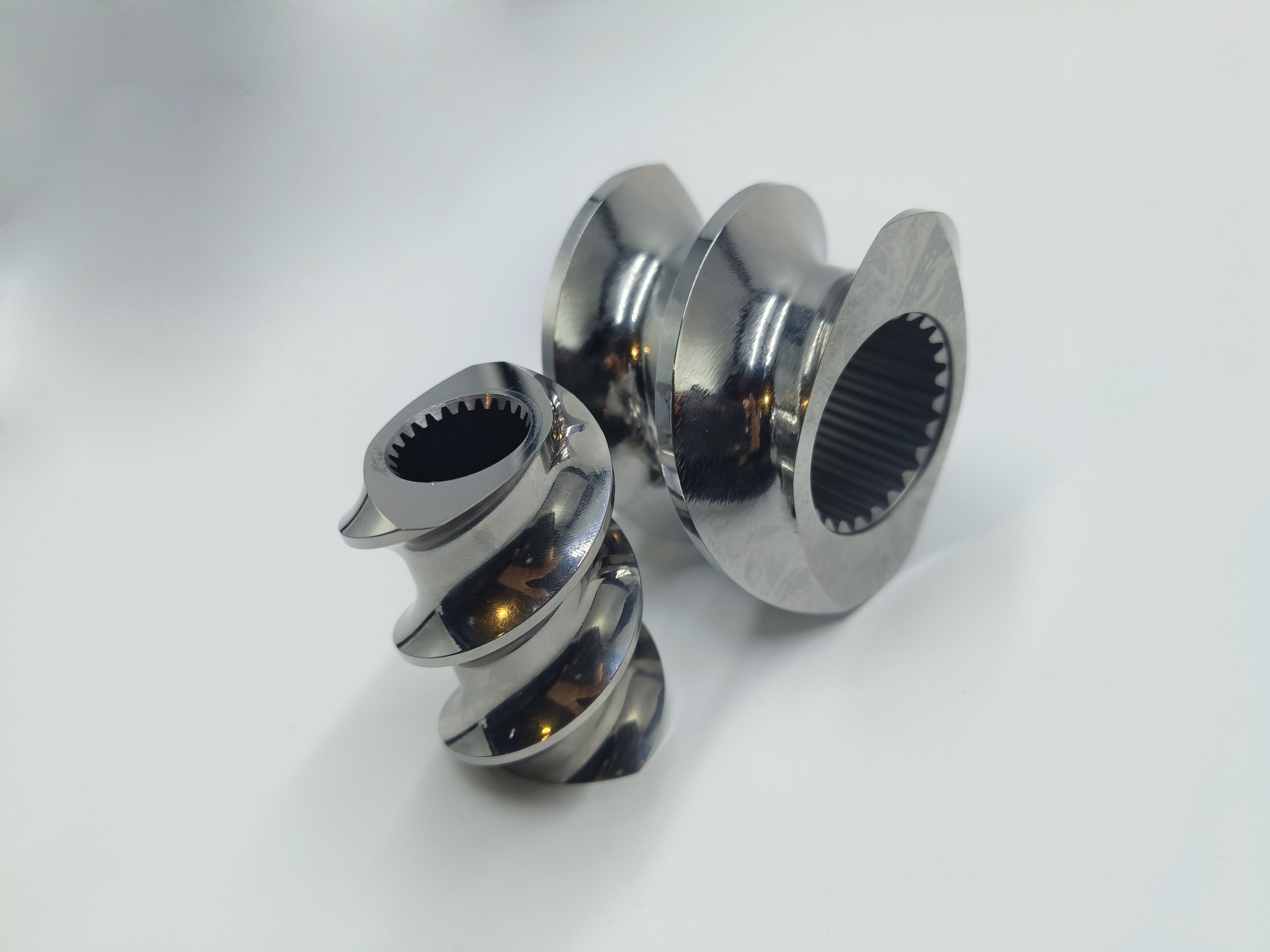
Product Name: Double-flighted Screw element
Model:φ11 mm ~φ350mm
Applicable Brands:Most well-known extruders on the market
Material: Tool steel, HIP, stainless steel, nickel-based alloy, cobalt-based alloy, etc.
Properties:Wear-resisting, Corrode-resisting and Durable
Structural Features:
Double-flighted screw elements feature two helical flights evenly distributed along the screw axis, forming two symmetrical screw channels. The pitch is typically designed in relation to the screw diameter, with the flights and core shaft forged as an integrated structure for enhanced strength. The surface undergoes hardening treatments (such as nitriding or hard chrome plating) to improve wear resistance. The depth of the screw channels is tailored to material properties—deeper channels suit high-viscosity materials, while shallower ones enhance shearing effects. The edges of the flights are rounded to minimize material retention and degradation risks, and some models may include reverse lead segments to achieve localized pressure boosting.
Functional Roles:
Balanced Conveying and Mixing Capability: The dual-channel design splits material flow into two paths during conveying, ensuring efficient material transport while enabling initial mixing through the shearing and tumbling action of the flights. This results in better mixing performance compared to single-flighted elements.
Moderate Shearing Intensity: Compared to single-flighted elements, double-flighted ones generate more uniform and moderate shear, which can disperse agglomerated particles without causing excessive degradation of heat-sensitive materials. This makes them suitable for processing most general-purpose plastics.
Pressure Gradient Control: By adjusting the flight lead and channel depth, the pressure distribution of materials within the barrel can be precisely regulated. For example, smaller leads in the melting section create high-pressure zones to promote material melting, while larger leads in the venting section reduce pressure to facilitate the release of volatile components.
Applications:
General Plastic Processing: Used in extrusion granulation, pipe, and film production for materials like PE, PP, and PS, they ensure uniform dispersion of additives (such as color masterbatches and antioxidants) while maintaining stable conveying.
Filled Modification Processes: Ideal for incorporating inorganic fillers (e.g., calcium carbonate, talc) into plastics, enhancing product rigidity and dimensional stability through moderate shear-induced uniform dispersion.
Venting Extrusion: Effective in processes requiring moisture or monomer removal (e.g., PET drying, PVC devolatilization), their pressure control capability enables efficient venting, ensuring low residual volatile content in the final product.
Auxiliary Reactive Extrusion: Serve as pre-mixing and conveying units in reactive extrusion, providing uniformly dispersed materials for subsequent reaction stages. For instance, they facilitate initial contact between compatibilizers and matrix resins in PA6/PP alloy production.
With their structural flexibility and balanced functionality, double-flighted screw elements are among the most widely used basic components in twin-screw extruders, particularly suited for processing materials sensitive to shear that require continuous, stable conveying.


