


Views: 0 Author: Site Editor Publish Time: 2026-06-09 Origin: Site


Operating an extrusion line presents a continuous operational tension. You constantly balance the need to maximize maintenance intervals against bleeding profitability through inefficient production. Running components until they catastrophically fail almost always guarantees massive unplanned downtime. Conversely, replacing parts prematurely inflates maintenance budgets unnecessarily. Deciding when to replace screw components requires moving away from visual guesswork. You must rely on measurable performance degradation, clearance tolerances, and clear unit economics. We will explore exactly how data-driven triggers can optimize your extruder maintenance schedules.
Throughput drop is the primary economic trigger: A 5–10% loss in specific throughput often costs more in lost yield than the price of new parts.
Clearance measurement dictates the timeline: Tolerances between the screw flight and barrel wall must be tracked systematically; exceeding OEM limits accelerates wear exponentially.
Not all replacements should be identical: Repeated failures in specific zones indicate a need to upgrade to wear-resistant screw elements.
Sourcing requires risk assessment: Choosing custom extruder spare parts over OEMs requires vetting metallurgical consistency and dimensional accuracy.
Running degraded components creates invisible leaks in your operational profitability. Many processors fail to notice the immediate financial impact of degraded geometries. The extruder continues to run, and the product initially looks acceptable. However, the underlying unit economics begin to shift drastically. The true cost of operating worn screw elements far exceeds the basic expense of spare parts. It directly degrades daily yield, spikes energy bills, and ruins material consistency.
Operators frequently compensate for lost conveying efficiency by increasing the screw speed (RPM). This manual adjustment seems harmless, but it introduces severe process instability. Higher RPM increases the shear forces acting upon the polymer melt. Elevated shear generates intense internal friction, which rapidly spikes melt temperatures. This excessive heat causes thermal degradation. It ultimately destroys the physical properties and molecular weight of your final product.
Energy consumption also spikes as geometries degrade. We track this metric using Specific Mechanical Energy (SME). When components lose their sharp edges, the extruder motor must work harder to achieve the same output. It draws more electrical current to maintain baseline production. This electrical inefficiency quietly drains facility resources month after month.
Quality rejection rates climb simultaneously. Degraded flight geometries fail to mix compounds consistently. Surging occurs at the die, leading to uneven pellet sizes or fluctuating profile dimensions. Out-of-spec end products force expensive material rework. The cost of running bad product for even a single shift often outweighs the investment required for fresh components.
Visual inspections alone rarely tell the whole story. Looking at a metal part cannot reveal microscopic clearance deviations. You need hard data to justify a conveying elements replacement. Shifting from qualitative guesses to quantitative tracking ensures you maximize component lifespan without sacrificing yield.
Tolerances between the screw flight and the barrel wall determine overall pumping efficiency. These gaps must remain incredibly tight to prevent polymer backflow. Standard acceptable clearances vary depending on the specific extruder diameter. You must measure the flight Outer Diameter (OD) using calibrated micrometers during routine maintenance teardowns.
Measuring correctly requires cleaning the part entirely. Any residual polymer skews the micrometer reading. You measure across the widest point of the flights and compare this number against original OEM specifications. Exceeding these baseline limits destroys the machine's pressure generation capability.
Typical Radial Clearance Action Thresholds | ||
Extruder Diameter (mm) | Standard New Clearance (mm) | Action Required Threshold (mm) |
|---|---|---|
20 - 30 | 0.10 - 0.15 | > 0.30 |
40 - 60 | 0.15 - 0.20 | > 0.45 |
70 - 90 | 0.20 - 0.30 | > 0.60 |
100+ | 0.30 - 0.40 | > 0.80 |
You must establish a strict baseline for Specific Throughput. We calculate this vital metric as kilograms per hour per RPM (kg/hr/rpm). When internal wear increases the clearance gap, molten material flows backward over the flights instead of moving forward. This backflow drastically reduces specific throughput over time.
A drop of 5–10% represents a critical economic threshold. At this exact point, the financial cost of lost daily production easily outpaces the cost of acquiring new replacement components. Monitoring this metric weekly allows you to predict replacement schedules months in advance.
Inconsistent die pressure signals severe mechanical wear inside the processing sections. The metering zone must build steady, reliable pressure to push the polymer through the die plate smoothly. Worn mixing or metering sections simply fail to hold this required pressure.
If you see erratic pressure gauge fluctuations, you likely have compromised geometries inside the barrel. These variations lead directly to surging. Surging ruins dimensional stability in pipes, films, and profiles. Tracking die pressure stability offers an immediate, real-time indicator of internal mechanical health.
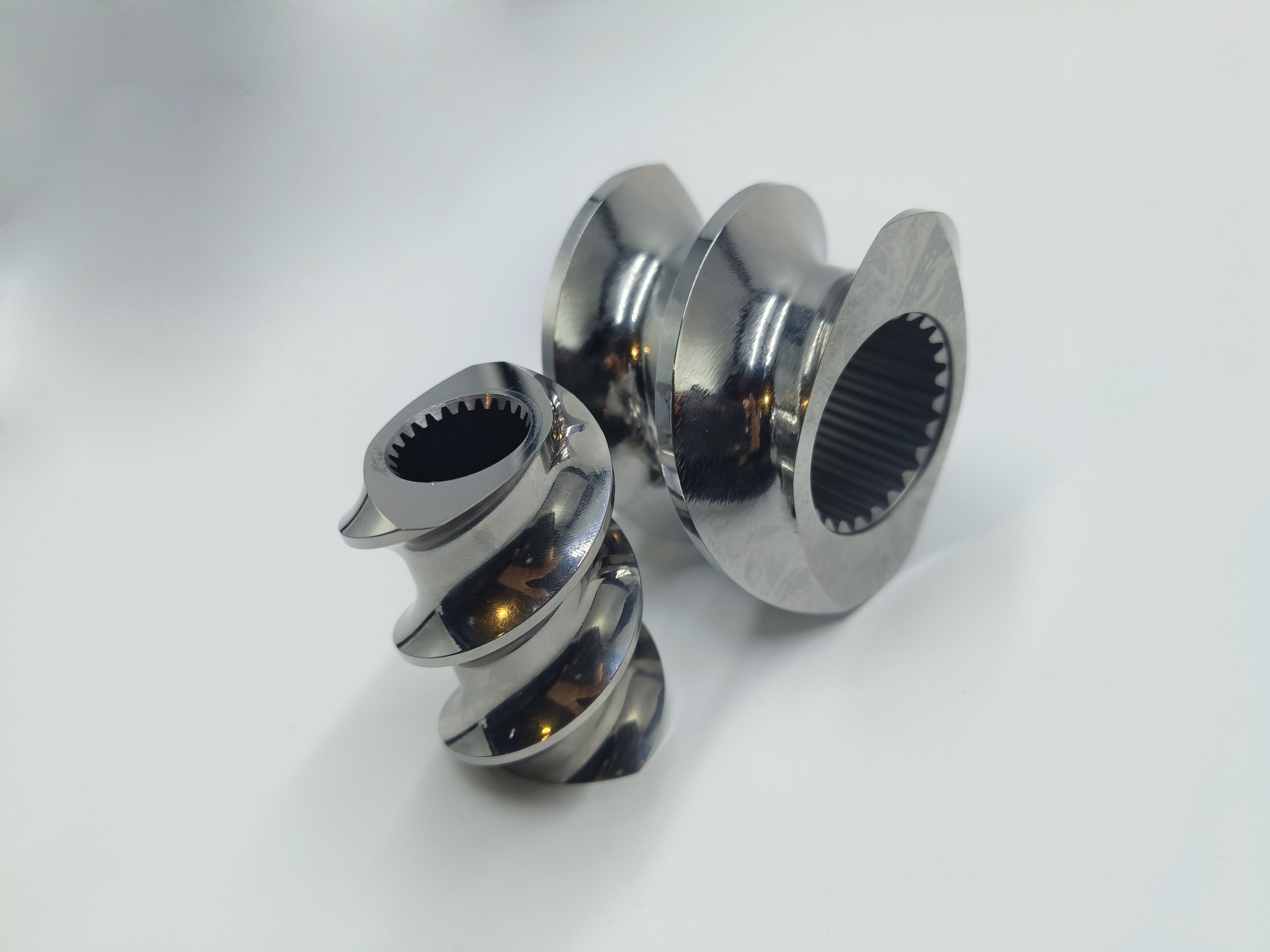
Understanding why a part failed prevents you from repeating the same mistake. You must differentiate normal degradation from systemic processing issues. An evidence-oriented reality check saves significant money and frustration during future changeouts.
Abrasive wear typically rounds off the leading edge of the flights. Compounding abrasive fillers like glass fibers, calcium carbonate, or titanium dioxide (TiO2) acts like liquid sandpaper inside the barrel. The continuous wiping action slowly grinds away the hardened metal surfaces. If you process highly filled materials, abrasive degradation represents your primary enemy.
Corrosive wear behaves differently. Processing fluoropolymers, PVC, or flame-retardant compounds often releases acidic gases at high melt temperatures. These gases attack the metal substrate directly. Corrosive wear causes distinct pitting and discoloration on the root of the screw, rather than just the outer edges. Standard nitrided steel offers almost zero protection against aggressive chemical corrosion.
Adhesive wear, commonly known as galling, involves violent metal-on-metal contact. You identify galling by deep scoring marks, torn metal fragments, or a sudden, catastrophic seizure of the machine. This rarely stems from normal polymer processing. It usually occurs due to severe shaft deflection, improper assembly, or excessive barrel wear.
Implementation Reality: Replacing the damaged part will not solve galling. If the underlying shaft is bent, or the barrel alignment is compromised, the new component will destroy itself within hours. You must address the root mechanical misalignment before installing any fresh parts.
Evaluating replacement materials based on actual process realities ensures better operational longevity. You must decide if standard nitrided steel remains sufficient, or if specialized alloys justify their higher initial investment. Repeated failures in specific high-stress zones strongly indicate the need for an upgrade.
When dealing with highly abrasive formulations, standard parts fail too quickly. Upgrading to wear-resistant screw elements becomes a mathematical necessity. Through-hardened tool steels, such as D2 or various CPM (Crucible Particle Metallurgy) grades, offer exceptional resistance to physical abrasion. They maintain their sharp geometric profiles significantly longer than basic nitrided alternatives.
For highly corrosive environments, metallurgy requires a different approach. You must evaluate encapsulated or specialized coated options. High-nickel alloys or nickel-cobalt base materials prevent acidic pitting. While these materials lack the extreme physical hardness of tool steels, they excel at resisting chemical attacks.
Material Selection Comparison Chart | |||
Material Type | Best Suited For | Hardness (HRC) | Relative Lifespan |
|---|---|---|---|
Standard Nitrided Steel | Unfilled polymers, general use | 60-64 (Surface only) | Baseline (1x) |
Through-Hardened (D2) | Moderate abrasive fillers (Talc, CaCO3) | 58-60 (Throughout) | 2x - 3x Baseline |
PM Tool Steel (CPM 10V) | High abrasion (Glass fiber, TiO2) | 60-63 (Throughout) | 4x - 6x Baseline |
Nickel-Based Alloys | High corrosion (PVC, Fluoropolymers) | 45-55 | Application specific |
Justifying the higher upfront cost relies on ROI calculations. You calculate the cost of the premium part against the extended operational lifespan. More importantly, you factor in the reduction of changeout downtime. Running a machine uninterrupted for an extra six months easily covers the premium price of high-performance metallurgy.
Navigating the vendor landscape objectively prevents costly procurement mistakes. The OEM route offers guaranteed fitment and predictable metallurgy. However, this safety comes with inherent drawbacks. OEMs typically command very high markups. They also enforce rigid lead times, which can leave you stranded during an unexpected breakdown.
Choosing an alternative route requires careful vetting. When evaluating manufacturers of custom extruder spare parts, you must look beyond the initial quote. A lower price means nothing if the part fails prematurely or destroys your shaft during installation.
Use the following criteria to evaluate alternative suppliers:
Assess their reverse-engineering capabilities. They must demonstrate the ability to capture exact spline geometries and flight profiles.
Verify current ISO certifications to ensure strict quality management systems exist within their manufacturing facility.
Demand complete transparency in their steel sourcing. Ask for mill certificates to confirm the exact alloy composition being used.
Trust indicators separate credible suppliers from risky machine shops. A reliable custom manufacturer will proactively provide comprehensive inspection reports. These documents should map exact dimensional tolerances against OEM standards. Furthermore, they must supply verifiable Rockwell hardness (HRC) data for every batch of components delivered.
Executing the actual replacement process requires precision and safety. Poor installation practices can ruin perfect parts in seconds. Addressing implementation realities upfront minimizes downtime and protects your equipment investment.
Shaft extraction presents the first major challenge. Components frequently seize on the splined shaft. This seizure typically results from degraded polymer leaking into the spline gaps, or from severe rust buildup. Using brute force to remove stuck parts often bends the shaft or damages the spline teeth. You must use proper extraction tools, penetrating fluids, and controlled heat to remove seized components safely.
Assembly best practices require meticulous attention to detail. The necessity of using high-temperature anti-seize compounds cannot be overstated. Applying a quality copper or nickel-based anti-seize prevents parts from fusing to the shaft during the next production cycle. Furthermore, you must strictly adhere to OEM torque specifications when tightening the shaft nut. Over-tightening creates immense pre-load stress, frequently leading to shaft breakage upon motor restart.
Clean all splines thoroughly with brass brushes before sliding new parts onto the shaft.
Never mix different metallurgies indiscriminately without understanding their thermal expansion rates.
Always double-check the directional orientation of the flights before finalizing the build.
A phased rollout approach prevents systemic failures. Replacing inner components without carefully checking the surrounding barrel wear remains a critical mistake. Putting a brand-new, tightly toleranced screw into a severely worn barrel cavity creates massive flow inefficiencies. The uneven gaps cause the new part to vibrate and drag against the metal walls. This mismatch accelerates wear on the new part exponentially, destroying your recent investment in mere weeks.
Deciding when to swap out your internal extrusion components is a mathematical decision, never a gut feeling. Tracking precise clearance tolerances, monitoring specific mechanical energy, and watching for specific throughput drops will protect your operational profitability. Relying on hard data ensures you extract maximum life from your equipment while avoiding costly yield losses.
Your immediate next step is to establish a baseline output metric today. Record your specific throughput (kg/hr/rpm) while the machine runs stably. Then, schedule a comprehensive dimensional inspection for your next planned shutdown. Armed with accurate micrometer readings and performance data, you can build an accurate, highly predictable replacement forecast for the coming year.
A: You should typically measure clearances during every major product changeover. If running a dedicated line, measure every 3 to 6 months. This frequency heavily depends on the abrasiveness of the compound being processed. Highly filled materials require more frequent monitoring.
A: Larger diameter elements can sometimes be rebuilt via hard-facing welding and precise re-machining. However, for smaller twin-screw profiles, the intensive labor cost of rebuilding almost always exceeds the cost of purchasing new, accurately machined replacement parts.
A: This situation usually indicates severe barrel wear. New components cannot build pressure effectively if the barrel wall inner diameter has expanded beyond acceptable tolerances. Polymer simply slips backward over the new flights through the enlarged barrel gap.


