


Views: 0 Author: Site Editor Publish Time: 2026-06-12 Origin: Site


Procurement and engineering teams frequently face a tough tradeoff today. They must balance material strength, unit cost, and geometric complexity when sourcing power transmission or motion control shafts. The manufacturing method you choose dictates ultimate component performance. Choosing between cold forming processes and subtractive machining directly impacts fatigue life. It also determines your production scalability and compliance against tight operational tolerances. Making the wrong choice can severely inflate costs or cause premature mechanical failures in the field. This guide provides a clear, evidence-based evaluation of these two distinct manufacturing methods. We will compare them head-to-head to help buyers align production processes directly to specific application requirements. You will learn how to evaluate volume needs and structural performance thresholds effectively. By the end, you will understand exactly when to use each method for optimal engineering results.
Cold rolling improves yield strength and surface hardness through work hardening and uninterrupted grain flow, making it ideal for high-stress applications.
Milled shafts offer superior geometric flexibility and tighter localized tolerances without the high upfront tooling costs of rolling dies.
For high-volume production of standardized profiles (like splines or threads), cold rolling drastically reduces per-unit costs and material waste.
Low-to-medium volume runs, or shafts requiring complex, non-linear features, are typically better suited for precision milling.
Understanding how we shape raw material forms the foundation of smart procurement. The basic mechanics of your chosen manufacturing method dictate nearly every physical property of the final part. We must look closely at material displacement compared to material removal.
Cold rolling plastically deforms metal at room temperature. The material passes between heavy rotating dies. These dies apply immense pressure to squeeze the raw stock into a desired shape. The process focuses entirely on material displacement rather than removal.
You effectively rearrange the metal at a molecular level. This rearrangement compacts the outer layers of the shaft. However, implementation reality introduces distinct engineering challenges. The intense pressure creates residual stresses within the metal. Engineers must carefully manage these stresses during the design phase. If ignored, the part may warp slightly over time. On the positive side, rolling yields zero material waste. You do not produce any metal shavings or swarf.
Specify normalized or annealed raw material stock before rolling.
Design for gradual feature transitions to allow smooth material flow.
Account for slight longitudinal growth as the material displaces outwards.
Milling takes a fundamentally opposite approach. It relies on subtractive manufacturing principles. High-speed rotary cutters shear away unwanted material from a solid blank. The machine meticulously carves the final shape out of the original block or rod.
This cutting action slices directly through the natural grain structure of the metal. Implementation reality shows milling is highly adaptable. You can execute mid-run design changes simply by updating the CNC program. The physical tooling does not need total replacement. However, subtractive processes generate significant scrap metal. They also require much longer cycle times per part compared to forming operations.
Designing deep, narrow pockets require fragile, extended-reach tooling.
Over-tolerancing non-critical surfaces drives up machining time unnecessarily.
Failing to account for tool deflection on long, slender shaft profiles.
We can summarize the fundamental differences between these manufacturing methods below.
Feature | Cold Rolling | CNC Milling |
|---|---|---|
Core Action | Plastic deformation | Material removal |
Scrap Generated | None (Zero Swarf) | High (Subtractive) |
Setup Time | Long (Custom Dies) | Short (Standard Tools) |
Cycle Time | Extremely Fast | Moderate to Slow |
Design Agility | Rigid (Costly to change) | Flexible (Software-driven) |
Mechanical performance dictates component lifespan in the field. How a shaft handles torque, bending moments, and heavy loads traces back to its structural integrity. Grain structure plays the most critical role here.
Raw metal contains a natural grain structure. Think of these grains like the fibers in a piece of wood. When we specify a cold rolling shaft, we preserve this internal architecture. The rolling dies force the grains to flow smoothly along the new contours of the part. This continuous, contour-following grain flow prevents weak points.
Furthermore, the cold working process naturally increases surface hardness. It also boosts the tensile strength of the part. Metallurgists call this phenomenon work hardening. The outer layer becomes densely packed and highly resilient.
Milled shafts behave differently. Subtractive machining severs the internal grain lines. The cutter chops right through the "wood fibers" of the metal. This severance creates microscopic stress concentrators. These weak points typically form at feature transitions. Shoulders, keyways, and sudden diameter changes become vulnerable to crack initiation under heavy loads.
Dynamic environments punish inferior components. Continuous grain flow proves absolutely critical for machinery experiencing heavy, reversing loads. When a shaft rotates under a side load, it undergoes constant tension and compression cycles. Microscopic surface tears can propagate into catastrophic fractures over time.
Let us look at a specific application context. Consider the demands placed on a high-torque extruder shaft. These components drive heavy, viscous materials through tight barrels. They endure massive rotational forces. A cold-rolled process provides superior torsional fatigue resistance. The unbroken grain boundaries absorb and distribute twisting forces safely. Machined alternatives in the same application might fail prematurely if not over-engineered or heat-treated heavily.
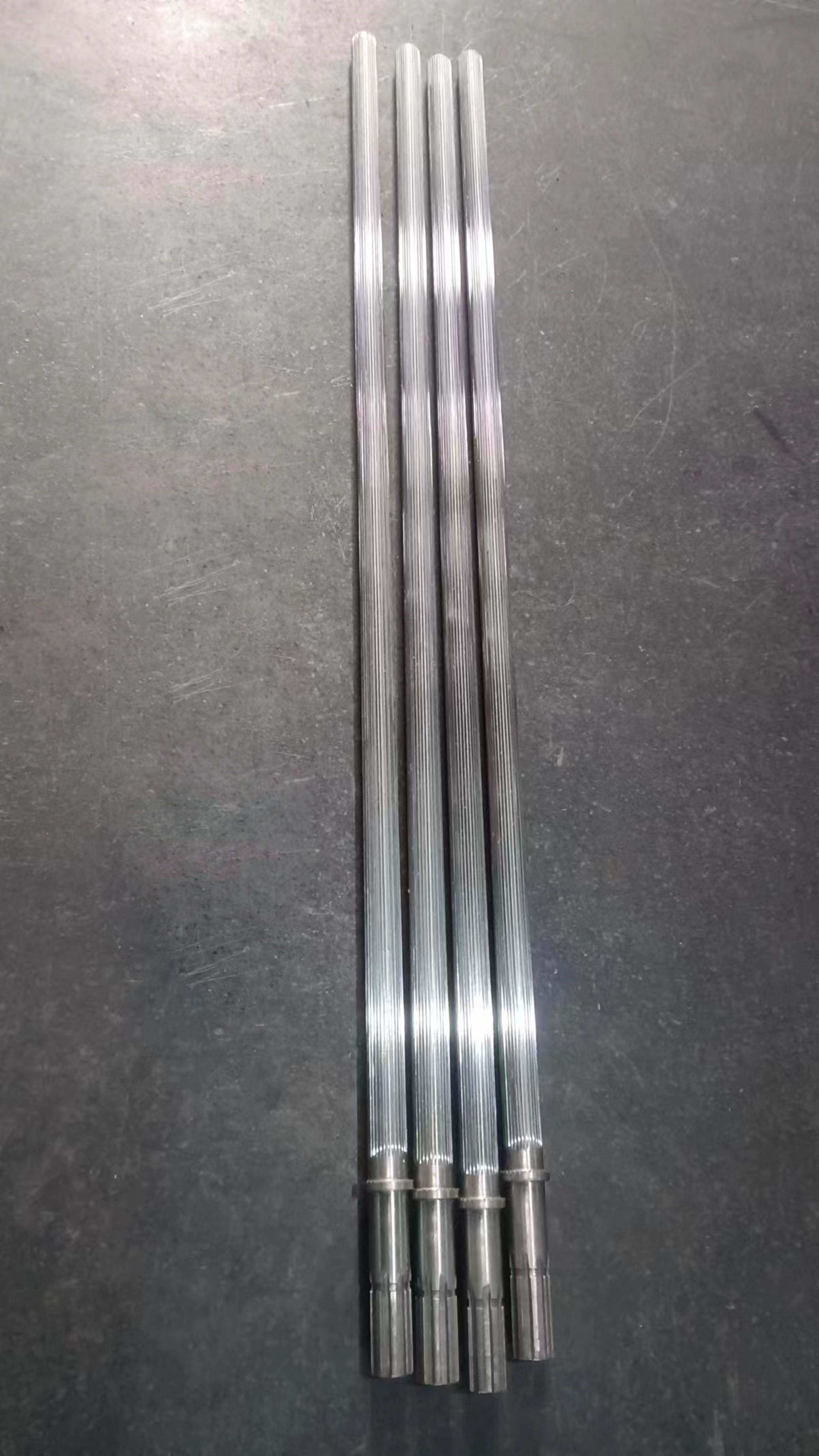
Surface quality and dimensional accuracy define assembly success. Bearings, seals, and couplings require exact fits to function properly. We must evaluate how each manufacturing method achieves these strict requirements.
Cold rolling inherently produces a burnished surface. As the dies compress the metal, they iron out microscopic peaks and valleys. You get a highly smooth, polished surface finish straight off the machine. This natural smoothness often eliminates any need for secondary grinding operations. You save both time and money on post-processing.
Milling leaves distinct tool marks. The rotating cutter creates a subtle scalloped pattern across the metal surface. Achieving a mirror-like finish requires specific, slowed-down feed rates. Even then, you might need secondary finishing operations like cylindrical grinding to achieve equivalent smoothness. This adds costly steps to your routing sheet.
While rolling wins on surface finish, machining dominates geometric complexity. A precision milling shaft excels when dealing with asymmetric features. CNC equipment effortlessly cuts complex cross-holes, non-linear splines, or distinct step-downs. Rolling simply cannot form these erratic geometries.
We can utilize a simple evaluation matrix chart to guide feature-level decisions.
Shaft Feature | Cold Rolling Suitability | Milling Suitability |
|---|---|---|
Continuous Threads | Excellent | Fair (Slower) |
Straight Splines | Excellent | Good |
Asymmetric Keyways | Poor (Impossible) | Excellent |
Transverse Cross-Holes | Poor (Impossible) | Excellent |
Multiple Diameter Steps | Fair (Requires custom dies) | Excellent |
Rolling proves superior for consistent linear profiles. Threads, continuous splines, and knurls roll beautifully. Milling wins for custom, multi-axis geometries where the profile changes drastically along the length.
Manufacturing decisions eventually come down to math. You must weigh upfront investments against long-term operational savings. The economic models for forming and cutting diverge sharply.
Cold rolling requires significant capital expenditure (CAPEX). You must purchase custom rolling dies made from hardened tool steel. Setup times run long. Technicians must calibrate the die pressures perfectly before starting the run. You can only justify this high initial investment through high-volume runs. However, once production begins, the cycle times are incredibly rapid. The per-unit cost drops dramatically as you amortize the tooling investment over thousands of parts.
Milling offers a much lower barrier to entry. Machine shops use standard CNC tooling inserts. They hold the raw material in standard chucks or collets. This approach makes subtractive processing highly cost-effective for prototyping. It also works perfectly for custom orders or low-volume runs. You do not pay for custom dies, but you pay a higher penalty in runtime per piece.
Material costs dominate modern supply chains. Subtractive manufacturing inherently wastes material. You might start with a three-inch diameter bar to machine a shaft with a two-inch main body and a single three-inch flange. You turn the majority of that expensive raw stock into scrap chips.
Cold rolling offers near-net-shape efficiency. You order raw stock closely matching the final mass of the part. The process simply moves the metal into the desired geometry. You pay only for the material you actually ship in the final product. Over a run of fifty thousand units, this material yield difference saves massive amounts of capital.
Choosing the correct path requires a structured approach. You must map your project constraints directly to the capabilities of each manufacturing method. Use the following framework to guide your supplier discussions.
Rolling becomes the undisputed champion under specific conditions. You should confidently specify this method when:
Volumes exceed 10,000+ units. High quantities easily absorb the steep tooling costs.
Profiles remain consistent. You need linear, repetitive shapes. Examples include lead screws, standard splined shafts, or a twin screw cold rolling shaft for industrial mixing machinery.
Maximum fatigue strength is required. Dynamic loads demand the uninterrupted grain flow and work-hardened surface rolling provides.
Material yield is a non-negotiable success criterion. You cannot afford to waste expensive alloys like aerospace-grade stainless steel.
Machining provides the agility needed for specialized engineering tasks. You should opt for subtractive methods when:
You run low to medium volume production. Prototyping stages and pilot runs cannot support heavy die investments.
High geometric complexity exists. Your design requires multi-axis CNC intervention for intersecting holes, flats, or offset cams.
Project timelines are critical. Long tooling lead times for custom dies might threaten your entire project rollout schedule. Standard CNC tools allow you to begin cutting metal immediately.
Do not make this decision in a vacuum. Guide your engineering team to consult with manufacturing partners early in the design phase. You need to run an overall cost analysis based on your specific CAD drawings and annual estimated usage (AEU).
Share your solid models openly. Ask your machining partners for constructive feedback. A slight design modification might allow you to switch from a costly milled part to a highly efficient rolled part. Small compromises on non-critical dimensions often unlock massive scalability.
Selecting the optimal shaft manufacturing process dictates product reliability and financial margins. Neither process proves universally superior across all applications. The correct choice hinges strictly on the intersection of production volume, required fatigue strength, and geometric complexity. Remember these core truths as you move forward.
First, specify forming operations to maximize strength and minimize material waste on high-volume runs. Second, leverage CNC machining for complex, highly detailed features during low-volume or prototyping phases. Finally, actively evaluate your 3D models for "design for manufacturability" (DFM). Challenge your engineering teams to adapt milled designs for cold forming wherever possible. Proactive design adjustments early in the cycle will save you tremendous costs as your product scales.
A: Yes, cold rolling induces work hardening. This physical deformation packs the grain structure tightly, significantly increasing surface hardness and yield strength. It achieves this without requiring immediate thermal treatment. Milling merely cuts away material and does not alter the base material's inherent mechanical properties.
A: Yes. It is standard practice to source a cold-rolled shaft for its superior baseline strength, continuous grain flow, and excellent surface finish. Manufacturers then use secondary milling operations to add specific localized features like keyways, transverse cross-holes, or flats.
A: Milling offers much shorter initial lead times because it utilizes standard off-the-shelf cutting tools. Cold rolling requires longer upfront lead times to engineer and manufacture custom hardened dies. However, once production begins, rolling produces parts at a significantly faster rate than milling.


