


Views: 0 Author: Site Editor Publish Time: 2025-09-09 Origin: Site


In twin screw extruders, selecting the correct screw elements—including conveying elements, kneading blocks, mixing elements, and transition elements—is critical for achieving efficient plastic processing, uniform melting, and high-quality output. Choosing the wrong type or configuration of screw elements can lead to a variety of operational challenges, negatively impacting both product quality and production efficiency.
Common consequences of incorrect screw element selection include poor material flow, uneven dispersion of additives, inconsistent melting, and excessive backpressure. These issues can result in product defects, such as streaks, voids, or weak mechanical properties, and may also cause extruder wear, energy waste, and unplanned downtime. In addition, improperly configured screws can lead to material build-up, stagnation zones, and inefficient residence time, which further disrupt the extrusion process and reduce overall productivity.
Understanding the potential problems caused by selecting inappropriate screw elements is essential for manufacturers. By identifying these issues early and applying corrective strategies, extrusion lines can operate more efficiently, maintain consistent product quality, and reduce costly interruptions.
Incorrect selection or configuration of screw elements in twin screw extruders can lead to several common problems that affect both plastic processing efficiency and product quality. Understanding these issues is essential for troubleshooting and optimizing extrusion lines.
Uneven Melt (Inconsistent Melting):
When screw elements are not properly matched to the material viscosity or polymer type, uneven shear and heat distribution can occur within the extruder. This results in incomplete melting, localized hot spots, or cold zones, which affect the polymer’s flow properties. Uneven melting can cause surface defects, streaks, or weak mechanical strength in the final product. For example, using insufficient kneading blocks or low-shear mixing elements for highly viscous polymers may prevent complete fusion, leading to quality inconsistencies.
Material Build-Up and Stagnation:
Improperly configured screw elements can create non-meshing zones or dead spots, where materials accumulate instead of flowing smoothly. This can result in material build-up, blockages, and backpressure, which not only disrupt the extrusion process but also increase the risk of downtime and maintenance needs. Transition elements, when incorrectly sized or positioned, may fail to connect different screw segments efficiently, exacerbating stagnation problems and reducing overall line efficiency.
Increased Energy Consumption:
Using inappropriate screw elements can lead to higher torque and motor load, as the extruder must work harder to move material through poorly configured sections. Excessive energy consumption increases operational costs and may accelerate wear on the extruder components. For instance, placing high-shear ZME elements where gentle dispersive mixing is sufficient can overwork the extruder, consume unnecessary energy, and potentially degrade heat-sensitive polymers.
Reduced Product Quality and Throughput:
The combination of uneven melt, material build-up, and increased energy consumption ultimately reduces product consistency, mechanical performance, and color uniformity. Additionally, extrusion throughput may decline as operators pause production to clear blockages or adjust screw configurations, leading to lower overall efficiency.
By understanding these common problems, manufacturers can identify whether screw element selection is the root cause of extrusion inefficiencies and take corrective measures to improve dispersion, melting, and material flow.
Understanding the root causes of extrusion issues is essential for diagnosing and preventing production inefficiencies. In twin screw extruders, many common problems—such as uneven melting, material build-up, and high energy consumption—can be traced back to improper selection or configuration of screw elements.
Kneading blocks are critical for providing shear, mixing, and material transport within the extruder. Each angle, such as 30°, 45°, 60°, or 90°, is designed for a specific function:
30° blocks primarily enhance material conveying with mild mixing.
45° blocks provide balanced mixing and moderate shear.
60° blocks offer intensive mixing and higher shear for thorough dispersion.
90° blocks deliver maximum shear and energy input for challenging polymers.
Using the wrong kneading block angle for a particular polymer or additive load can cause inadequate mixing, incomplete melting, or excessive shear, leading to material stagnation or degradation. For example, a high-viscosity filled polymer processed with 30° blocks may not achieve uniform melting, while using 90° blocks on a delicate polymer could cause thermal degradation.
Mixing elements (SME, TME, ZME) and transition elements are designed to manage material flow, dispersion, and pressure. Selecting the wrong type can result in several extrusion problems:
Using low-shear SME elements for highly filled or viscous compounds may lead to insufficient dispersion and uneven melt.
Choosing ZME elements for low-viscosity materials can cause excessive shear, higher energy consumption, and potential material degradation.
Incorrectly sized or positioned transition elements can create non-meshing zones, material build-up, and backpressure, disrupting smooth extrusion.
By carefully evaluating material characteristics, viscosity, filler content, and thermal sensitivity, manufacturers can select the most appropriate kneading blocks, mixing elements, and transition elements. Correct selection ensures smooth material flow, uniform melting, and consistent dispersion, preventing the common problems that arise from mismatched screw components.
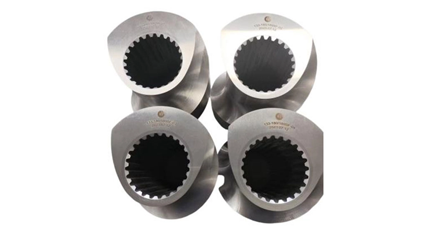
Correcting problems caused by incorrect screw element selection is essential for restoring efficient and high-quality plastic processing in twin screw extruders. There are two main strategies: reconfiguring the screw element combination and upgrading to high-performance elements.
One of the most effective ways to resolve extrusion issues is to reassess and adjust the arrangement of screw elements. This may include:
Replacing kneading blocks with the correct angle (30°, 45°, 60°, 90°) to match the polymer viscosity and processing requirements.
Adjusting the sequence of conveying elements, kneading blocks, and mixing elements to ensure smooth material transfer, uniform dispersion, and optimal melting.
Incorporating or repositioning transition elements to reduce non-meshing zones, prevent material build-up, and maintain consistent backpressure.
Proper reconfiguration ensures that each section of the extruder performs its intended function, resulting in even melting, efficient dispersion, reduced energy consumption, and minimized downtime.
In many cases, replacing standard screw components with precision-engineered, high-performance elements can address persistent extrusion problems. Upgraded elements offer:
Enhanced shear and mixing capabilities for challenging polymers or highly filled compounds.
Improved wear resistance, ensuring long-term durability even when processing abrasive materials.
Optimized geometries for better material flow, self-cleaning action, and consistent dispersion.
For instance, replacing low-shear SME elements with ZME high-shear mixing elements can achieve thorough pigment or filler dispersion in viscous compounds, while precision transition elements can reduce stagnation and build-up, ensuring continuous production.
By carefully analyzing the root causes and applying these corrective strategies, manufacturers can restore extrusion efficiency, improve product quality, and reduce operational costs. Implementing the right combination of conveying elements, kneading blocks, mixing elements, and transition elements is key to achieving reliable, high-performance extrusion in modern plastic processing lines.
Preventing problems caused by incorrect screw element selection is essential for maintaining continuous and efficient extrusion. Manufacturers can implement several preventive strategies to optimize performance and reduce downtime:
Regular Inspection and Maintenance:
Periodically check the condition of all screw elements, including conveying elements, kneading blocks, mixing elements, and transition elements, for wear, deformation, or material buildup. Early detection of potential issues allows operators to replace or adjust components before they impact extrusion efficiency or product quality.
Optimize Screw Design Based on Material Characteristics:
Carefully select and configure screw elements according to polymer type, viscosity, filler content, and thermal sensitivity. For example, highly filled compounds may require ZME high-shear mixing elements and appropriately angled kneading blocks to ensure uniform dispersion and complete melting. Transition elements should be placed to minimize non-meshing zones, reducing material stagnation and build-up. By matching screw design to the material, extrusion lines can achieve consistent flow, uniform melting, and reduced energy consumption.
Monitor Process Parameters:
Keep track of temperature, pressure, torque, and residence time to ensure that the screw configuration is performing optimally. Adjusting processing parameters in combination with proper screw element selection further prevents common extrusion problems and extends the life of the extruder.
Incorrect screw element selection can lead to uneven melting, material build-up, increased energy consumption, and reduced product quality. By implementing preventive measures—such as regular inspections, material-based screw design optimization, and careful process monitoring—manufacturers can minimize downtime and enhance extrusion efficiency.
Gendrre All Rights Reserved. offers expert consultation and precision-engineered screw elements, including conveying elements, kneading blocks, mixing elements, and transition elements. Our solutions are designed to maximize throughput, ensure uniform dispersion, and reduce maintenance costs, helping your extrusion lines operate smoothly and reliably.
For manufacturers seeking to improve product quality and reduce downtime, consulting Gendrre for customized screw element solutions is the first step. Visit www.gendrre.com or contact our team today to explore advanced designs tailored to your plastic processing needs.


