


Views: 0 Author: Site Editor Publish Time: 2025-03-13 Origin: Site


In modern industrial automation, the screw feed mechanism is a key component in countless manufacturing and processing operations. Often called a screw feeder or auger feed mechanism, this device is designed to transport, meter, and control the flow of materials in a consistent and efficient way. Unlike manual or gravity-based feeding, the screw feed mechanism uses the rotation of a helical screw inside a housing to move materials predictably and precisely.
To understand its uses, it helps to look at its core functions, typical applications, design variations, and the value it brings to production processes.
The primary functions of a are material conveying, controlled feeding, and in some cases, material conditioning. Its main components include a helical screw, a housing (tube or trough), a drive unit, and a hopper for material storage.
When the screw rotates, it pushes material forward along the housing. The screw pitch, diameter, and rotation speed determine the material flow rate, which can be adjusted to suit different production needs. The housing keeps the material moving linearly, preventing it from spinning with the screw. This design ensures uniform feeding, even for powders, granules, viscous substances, or sticky materials.
The versatility of the screw feed mechanism comes from its ability to handle a wide range of materials, including powders, granules, pellets, small blocks, and semi-solids. Here are the main industries where it plays a critical role:
In food production, screw feeders move ingredients such as flour, sugar, grains, or chocolate into mixers and processing lines. Their enclosed design prevents dust, moisture, and contamination, helping maintain product quality and hygiene. Some feeders can also handle semi-solid materials like syrups or dough.
In pharmaceuticals, screw feeders ensure accurate dosing of powders, granules, and active ingredients. They are often used in cleanroom environments with easy-to-clean, sealed designs. Twin-screw or gravimetric feeders maintain consistency in tablets or capsules, reducing human error.
Screw feed mechanisms transport abrasive, sticky, or corrosive materials, such as catalysts, resins, or fertilizers. Their robust construction allows safe operation in challenging environments, including pressurized or vacuum systems.
Agricultural and feed industries use screw feeders to handle grains, protein sources, vitamins, and minerals. By delivering a steady, controlled feed, these mechanisms help optimize production and reduce material waste.
Screw feeders are also applied in handling sludges, biomass, or recycled materials. Their design accommodates bulky or moist substances, making them ideal for biogas production, waste processing, and recycling operations.
From coal to cement, screw feeders move heavy, abrasive materials where other systems may not fit. Their compact design allows operation in confined spaces or at steep angles.
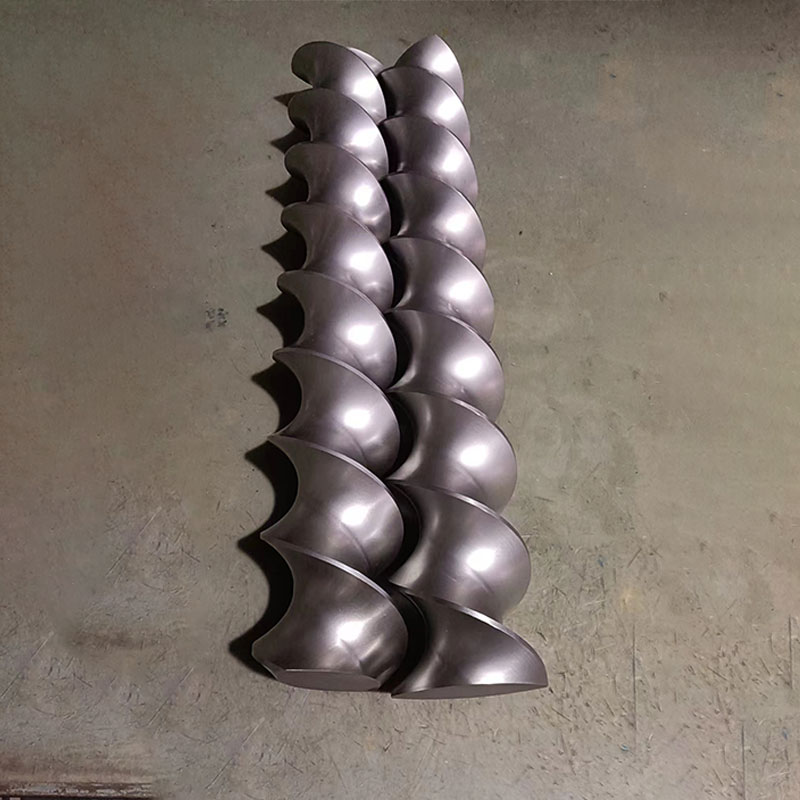
Different designs suit different applications:
Single Screw Feeder: Simple, cost-effective, ideal for free-flowing powders and granules.
Twin Screw Feeder: Handles sticky or cohesive materials with higher accuracy.
Volumetric Feeder: Controls flow based on volume for bulk materials.
Gravimetric Feeder: Uses weight-based control for precise dosing.
Flexible Screw Feeder: Portable and adaptable for confined spaces or small-scale operations.
Selecting the right type depends on material properties, desired flow rate, and operating conditions.
Screw feed mechanisms provide:
Consistency: Maintains uniform material flow.
Versatility: Works with a wide range of materials.
Compact design: Fits in spaces unsuitable for conveyors.
Sealed operation: Reduces contamination and protects workers.
Ease of maintenance: Simple components with fewer moving parts.
These benefits make them essential in industries that prioritize precision, reliability, and efficiency.
Industrial automation has brought new developments:
Smart monitoring: Sensors track flow and performance for predictive maintenance.
Energy efficiency: Variable speed drives reduce power consumption.
Modular designs: Components can be swapped or upgraded for different materials.
Improved material handling: New coatings and materials allow handling of sticky, abrasive, or sensitive substances.
These trends make screw feed mechanisms even more flexible and efficient for modern production needs.
Q1: What materials can a screw feed mechanism handle?
Powders, granules, pellets, semi-solids, sticky or moist substances, and abrasive or corrosive materials with specialized designs.
Q2: How is it different from a conveyor?
Screw feeders provide controlled and metered feeding, while conveyors mainly move material without precise flow control.
Q3: Can it mix materials while feeding?
Yes, certain designs (e.g., twin or ribbon screws) can mix or homogenize materials during transport.
Q4: How do I choose the right type?
Consider material type, accuracy requirements, feed rate, operating environment, and space constraints.
The screw feed mechanism is more than a material transporter. Its ability to deliver controlled, precise, and consistent flow makes it essential across food, pharmaceutical, chemical, agricultural, and environmental industries. With modern smart designs, energy efficiency, and modular flexibility, screw feeders continue to play a vital role in improving product quality, operational efficiency, and reliability in industrial automation.


